Driving Through Nouakchott: Where Open Spaces Tell Stories
You know what’s wild? Exploring Nouakchott not from a tour bus, but behind the wheel, where every stretch of open space feels like a whispered secret. I drove through dusty avenues and quiet plazas, watching life unfold in parks, markets, and roadside clearings—the city’s true heartbeat. These public spaces aren’t just empty land; they’re where people gather, trade, rest, and connect. If you think Mauritania’s capital is all desert and silence, think again. This is real, raw, and totally unforgettable.
The Unexpected Pulse of Nouakchott
Nouakchott, often dismissed as a remote desert capital, reveals its true character not in grand monuments or high-rises, but in the vast open spaces that define its urban fabric. As you drive through the city, the first thing that strikes you is the openness—wide boulevards, low buildings, and expanses of sandy ground that could easily be mistaken for vacant lots. But these are not empty zones. They are the lungs of the city, breathing life into daily routines. The rhythm of Nouakchott pulses through these communal areas, where children kick footballs across packed earth, women in colorful melayahs carry goods on their heads, and elders sit on low stools beneath makeshift awnings, sharing stories over steaming glasses of sweet mint tea.
Unlike more densely packed African capitals, Nouakchott’s layout is shaped by necessity and climate. Built on the edge of the Sahara and along the Atlantic coast, the city spreads outward rather than upward. This horizontal growth has created a unique urban environment where public space is not confined to designated parks or plazas but is woven into the very structure of the city. As you drive, you begin to see patterns—how certain clearings swell with activity in the morning, while others come alive at dusk. These rhythms are not accidental; they reflect the deep social function of open ground in a place where formal infrastructure is still developing.
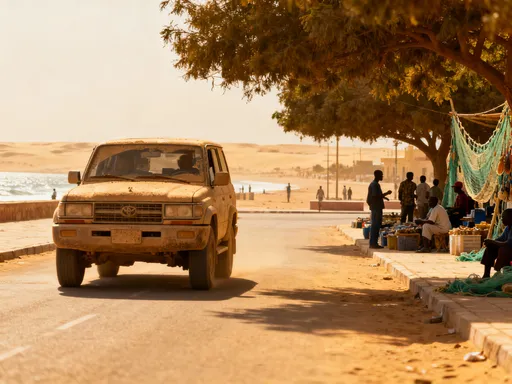
What makes Nouakchott’s open spaces so vital is their accessibility. There are no entry fees, no gates, no strict rules about who can use them. They belong to everyone. A patch of shade beneath a eucalyptus tree becomes a meeting point. A cleared lot beside a mosque transforms into a playground after prayers. Even the unpaved margins of main roads host small-scale commerce—men selling bottled water, women offering fresh pomegranate juice from clay jugs. Driving through the city, you realize that these spaces are not just background scenery—they are the stage upon which daily life unfolds.
Why Driving Changes Your Perspective
Seeing Nouakchott from behind the wheel offers a fundamentally different experience than riding in a taxi or joining a guided tour. When you drive yourself, you control the pace, the route, and the moments of pause. You can stop where others speed past. You can linger at a roadside market, observe a group of boys playing dominoes under a tarp, or watch fishermen hauling nets in silence along the shore. This autonomy transforms sightseeing into something deeper—immersion. You’re no longer just observing the city; you’re moving through it, absorbing its rhythms at human scale.
Self-driving also allows you to discover the city’s hidden layers. Tourist itineraries often focus on a few key landmarks—the National Museum, the Grand Mosque, the Central Market—but these represent only a fraction of what Nouakchott has to offer. The real story lies in the in-between spaces: the open ground behind apartment blocks, the sandy stretch beside the train tracks, the quiet plaza where women gather to wash clothes in communal basins. These places rarely appear on maps, but they are where life happens. Driving gives you the freedom to wander off the main arteries, to follow your curiosity down unpaved side streets and see how people adapt to their environment.
Of course, driving in Nouakchott comes with practical considerations. Road conditions vary widely—some main roads are well-paved and clearly marked, while others are little more than compacted sand, especially in newer or peripheral neighborhoods. A 4x4 vehicle is recommended, particularly if you plan to explore beyond the central districts. Fuel stations are available throughout the city, though they can be crowded during peak hours. Navigation can be challenging, as street signs are sparse and many areas are not well-documented on digital maps. A local SIM card with data access can help, but carrying a printed map or using offline GPS apps like Maps.me is wise. Most importantly, patience is key. Traffic moves at its own pace, and drivers often follow unwritten rules more than formal regulations.
Yet these challenges are part of what makes self-driving so rewarding. Each detour, each wrong turn, leads to a new discovery. You learn to read the city not through signs, but through patterns—the flow of foot traffic, the clustering of vendors, the way shade shifts across a square as the sun moves. This kind of slow, attentive travel fosters a deeper connection to place. It’s not about checking off attractions; it’s about understanding how a city breathes, how people carve out space for community in a landscape shaped by heat, wind, and resilience.
Central Market Grounds: More Than Just Commerce
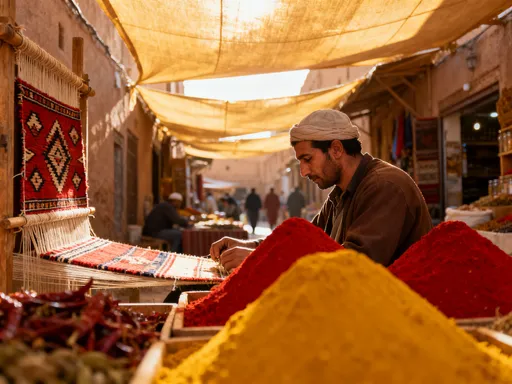
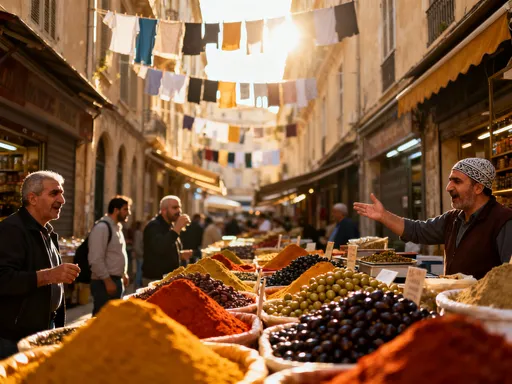
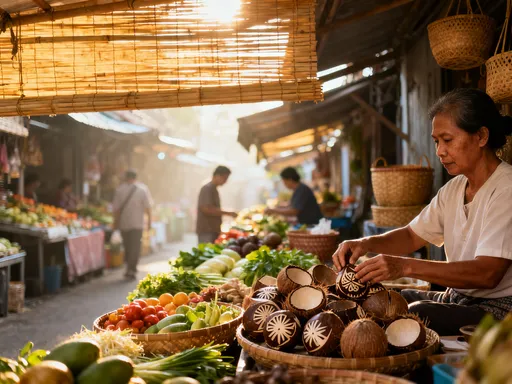
No visit to Nouakchott is complete without spending time at El Khor, the city’s sprawling central market. But to think of it merely as a place to buy goods is to miss its deeper role. The market grounds are one of the city’s most important social spaces, a vibrant crossroads where commerce, conversation, and culture intersect. As you drive up to the edge of the market, the first thing you notice is the noise—the hum of voices, the clatter of wooden carts, the occasional bleat of a goat being led to auction. The air carries a mix of scents: dried fish, fresh herbs, leather, and diesel fumes. This is not a sanitized shopping center; it’s a living, breathing organism.
The market spreads across several open blocks, with rows of stalls under corrugated metal roofs and shaded canopies. Vendors sell everything from spices and grains to textiles and mobile phone chargers. But what’s striking is how much of the space is devoted not to selling, but to being. Along the edges, low plastic chairs and woven mats create informal seating areas. Men gather in small groups, sipping tea and discussing politics or football. Women pause between errands to exchange news or share a laugh. Children dart between stalls, chasing each other or begging for sweets. These moments of rest and connection are not incidental—they are essential to the market’s function as a public square.
In a city where private gathering spaces are limited, the market becomes a kind of living room for the community. It’s where people come not just to shop, but to see and be seen. News travels fast here—job opportunities, family updates, local events—all shared over shared tea or during slow bargaining. The market also serves as a neutral ground where different ethnic and social groups interact. You’ll hear Hassaniya Arabic, Pulaar, Soninke, and Wolof spoken in close proximity, a reminder of Mauritania’s rich cultural mosaic. This diversity is not just tolerated; it’s woven into the daily rhythm of exchange.
For visitors, the market offers a rare opportunity to witness authentic urban life. But it also demands respect. Photography should be done discreetly and only with permission. Dressing modestly is essential—long sleeves, covered shoulders, and non-revealing clothing. Walking slowly and observing without intrusion allows you to absorb the atmosphere without disrupting it. When you do engage, a simple greeting in Arabic—"Salam alaikum"—opens doors more than any camera ever could. The market is not a performance for tourists; it’s a real space with real lives unfolding. To experience it fully, you must be present, not just as a spectator, but as a respectful guest.
Urban Parks and Green Respite
In a city where temperatures regularly climb above 40°C (104°F), shade is a luxury. That’s what makes Nouakchott’s small green spaces so precious. Park Ibn Khaldoun, one of the few formal parks in the capital, stands as a quiet oasis amid the dust and heat. As you pull into the nearby lot and step out of the car, the change is immediate—the air feels cooler, the noise softer. Palm trees line the pathways, and patches of grass, though sparse, offer a rare splash of green. Families sit on benches or spread mats under the trees, escaping the midday sun. Students read under umbrellas, workers take lunch breaks, and couples stroll along the perimeter, enjoying a rare moment of peace.
These green spaces serve a vital function beyond recreation. In an arid urban environment, they provide psychological relief as much as physical comfort. The simple presence of trees and grass offers a sense of balance, a reminder that life persists even in harsh conditions. Park Ibn Khaldoun, though modest in size, is meticulously maintained. Watering schedules are carefully managed, and park staff ensure cleanliness and safety. This level of care reflects the value placed on such spaces in a city where nature is not abundant. For many residents, a visit to the park is not a casual outing but a necessary retreat—a chance to breathe, reflect, and reconnect with family.
What’s remarkable is how these spaces are used. Unlike in some cities where parks are dominated by joggers or dog walkers, in Nouakchott, the emphasis is on stillness and togetherness. People come to sit, to talk, to rest. Teenagers gather in corners, listening to music on shared phones. Elderly men play checkers on foldable boards. Mothers rock babies in their arms, shaded by wide hats. The park becomes a stage for everyday intimacy, a place where the simple act of being together is celebrated. Even in the heat, there is a sense of calm, a rhythm that resists the urgency of city life.
While Park Ibn Khaldoun is the most well-known, smaller green areas exist throughout the city—community gardens, school courtyards, and roadside plantings. These too serve as micro-sanctuaries, offering brief respites from the urban grind. Their presence, though limited, signals a growing awareness of the importance of green infrastructure in urban planning. For visitors, these spaces offer a quieter, more reflective side of Nouakchott—one that balances the bustle of the markets and the vastness of the open desert.
Coastal Open Spaces: The Atlantic’s Quiet Edge
The Atlantic coast defines Nouakchott’s western edge, and along this frontier, open space takes on a different character. Here, the city meets the ocean in a landscape of wide beaches, rocky outcrops, and long, sweeping boulevards. Driving along Avenue du President or the coastal road near the fishing port, you’ll notice how these spaces blend utility and leisure. Fishermen spread their nets on the sand to dry, repairing them with practiced hands. Boats rest on the shore, their wooden hulls painted in bright blues and greens. Children run between the vessels, chasing each other or flying handmade kites in the steady breeze.
At sunset, the coast becomes one of the city’s most popular gathering spots. Families spread mats on the sand, sharing meals as the sky turns gold and pink. Couples walk hand in hand along the water’s edge. Young men play football on the hard-packed shore, their laughter carried away by the wind. Unlike more commercialized beachfronts in other capitals, Nouakchott’s coast remains largely unstructured—there are no boardwalks, no souvenir stalls, no loud music. What exists is organic, shaped by the needs and rhythms of local life.
The fishing industry is central to this coastal culture. The port area, while not a tourist destination, is a vital economic hub. Watching the daily catch being unloaded—tuna, barracuda, octopus—offers a glimpse into a way of life that has changed little over generations. The fish are sorted, weighed, and quickly sold to vendors who carry them inland on bicycles or in small trucks. This cycle, repeated every day, underscores the practical function of the coastal open spaces. They are not just scenic; they are essential to the city’s survival.
For visitors, the coast offers a chance to experience Nouakchott’s quieter, more contemplative side. Walking along the shore, you feel the vastness of the ocean and the humility it inspires. The sound of waves, the smell of salt, the endless horizon—all serve as a counterpoint to the dust and noise of the city center. Driving here, especially in the early evening, allows you to witness this transition from labor to leisure, from work to rest. It’s a reminder that in Nouakchott, even the most utilitarian spaces are also places of beauty and connection.
Informal Public Zones: Life Between the Lines
Some of the most vibrant public spaces in Nouakchott are not on any map. They are the in-between places—the empty lots, the roadside clearings, the shaded curbs where life finds a way to gather. These informal zones are a testament to the adaptability of urban communities. With limited access to formal parks, community centers, or recreational facilities, people make do with what’s available. A patch of hard-packed earth becomes a football pitch. A row of trees beside a road turns into an impromptu café, where men sip tea and debate the day’s news. A corner near a mosque serves as a prayer space during Friday gatherings.
These spaces are not planned, but they are deeply functional. They emerge from necessity and grow through repetition. Over time, they develop their own rhythms and rules, known intuitively by those who use them. A certain lot is for children in the morning, for vendors in the afternoon, for elders in the evening. A shaded wall becomes a resting spot for laborers between shifts. A wide sidewalk hosts a rotating cast of fruit sellers, shoeshiners, and phone chargers. These uses are not written down, but they are understood—a kind of invisible social contract.
What makes these informal zones so powerful is their inclusivity. They require no admission, no membership, no status. Anyone can use them, and they serve people from all walks of life. A university student might sit beside a fisherman, both enjoying the same breeze. A mother nursing her baby might share space with a mechanic taking a break. These moments of quiet coexistence are the fabric of urban resilience. They show how communities create connection even when infrastructure falls short.
For the observant traveler, these spaces offer some of the most authentic insights into daily life. Driving slowly through residential neighborhoods, you begin to notice them—how certain corners always seem to have people, how certain stretches of road hum with quiet activity. These are not accidents. They are the result of careful, unspoken negotiation between people and place. To understand Nouakchott, you must learn to see these spaces not as voids, but as vital nodes of social life. They are where the city’s spirit lives—not in grand designs, but in the small, persistent acts of gathering, resting, and being together.
Responsible Exploration: Respecting Local Norms
As rewarding as self-driving through Nouakchott can be, it comes with a responsibility to engage respectfully. The city’s open spaces are not tourist attractions; they are part of people’s daily lives. Dressing modestly—covering shoulders, arms, and legs—is not just a cultural expectation but a sign of respect. Lightweight, breathable fabrics in neutral or earth tones are ideal for both comfort and appropriateness. When photographing, always ask permission before taking pictures of people, especially women and children. A smile and a simple gesture can go a long way in building trust.
Driving through residential or religious areas requires extra sensitivity. Avoid honking unnecessarily, especially near homes or mosques. Keep noise to a minimum during prayer times. Be mindful of where you park—don’t block driveways, entrances, or shaded resting spots. If you’re unsure whether an area is appropriate to enter, it’s better to err on the side of caution and observe from a distance. Some neighborhoods may have informal boundaries that aren’t marked but are well understood by locals.
Engaging with vendors or residents should be done with humility and patience. Bargaining is common in markets, but it should be friendly, not aggressive. A cup of tea offered by a local is often an invitation to conversation, not just a transaction. Accepting it graciously can open doors to deeper understanding. Above all, remember that you are a guest in a city shaped by its own history, values, and rhythms. Your presence should be quiet, observant, and appreciative.
Conclusion
Nouakchott’s soul is not found in its buildings or borders, but in its open spaces—those wide, sunlit expanses where life gathers, unfolds, and persists. Driving through the city, you come to see that these spaces are not empty, but full: full of stories, of connections, of quiet resilience. From the bustling market grounds to the serene coastal edge, from formal parks to informal clearings, each area tells a part of the city’s story. What makes this journey so powerful is the pace—behind the wheel, you move slowly enough to notice, to feel, to understand.
This kind of travel is not about spectacle. It’s about presence. It’s about recognizing that the most meaningful experiences often happen in the margins—in a shared smile at a roadside tea stand, in the sound of children laughing on a dusty lot, in the sight of fishermen mending nets under a setting sun. To drive through Nouakchott is to witness a city that thrives not despite its challenges, but because of the strength of its people and the spaces they create together.
For those willing to look beyond the surface, Nouakchott offers a rare gift: the chance to see urban life in its most authentic form. It invites you to slow down, to listen, to respect. And in return, it reveals a world of connection, dignity, and quiet beauty. The open spaces tell stories—if you’re willing to stop, step out, and listen, you might just hear them.