You Won’t Believe These Views in Graz – A Must-See Skyline Escape
Graz, Austria, isn’t just a city of art and history—it’s a hidden gem for unforgettable views. From hilltop lookouts to modern architecture with panoramic terraces, the scenery stops you in your tracks. I didn’t expect such breathtaking perspectives in this underrated destination. If you're chasing authentic viewing experiences with a local twist, Graz delivers. Let me take you through the spots where the city unfolds beneath your feet—calm, colorful, and completely captivating.
Why Graz Deserves a Spot on Your View-Seeking List
Graz, the second-largest city in Austria, sits nestled in the southeastern part of the country, where the Alps meet gentle rolling hills and lush river valleys. Often overshadowed by Vienna’s imperial grandeur, Graz offers a more intimate and grounded travel experience—one where beauty reveals itself not in opulence, but in harmony between nature and urban life. With a population of just over 300,000, it maintains a human scale, yet boasts a rich tapestry of architectural styles spanning centuries. Its city center is a UNESCO World Heritage Site, recognized for its seamless blend of Renaissance, Baroque, and contemporary design. This unique fusion creates an urban landscape that rewards the observant traveler with unexpected visual contrasts and layered perspectives.
What truly sets Graz apart for view-seekers is its topography. The city rises and falls along the contours of surrounding hills, with the Mur River carving a graceful path through its heart. Elevation changes are subtle but meaningful—just enough to create natural vantage points without demanding extreme hikes. Schlossberg, the forested hill at the city’s core, rises about 475 meters above sea level, offering an immediate sense of verticality. From its summit, the city spreads out like a living map, its red-tiled roofs, church spires, and modern structures forming a mosaic that tells the story of centuries. This blend of accessibility and scenic payoff makes Graz ideal for travelers who appreciate beauty without the burden of strenuous climbs or tourist crowds.
Moreover, Graz’s commitment to green spaces enhances its visual appeal. Parks like the Stadtpark and the Botanical Garden provide tranquil oases within the urban fabric, while tree-lined avenues and pedestrian zones invite slow, thoughtful exploration. The city’s emphasis on sustainability and livability means that even its modern developments—like the Murinsel and Kunsthaus—are designed with public enjoyment in mind, including open spaces and sightlines that prioritize human experience. For those who value both authenticity and aesthetic pleasure, Graz offers a rare balance: a city that feels lived-in, yet consistently surprises with moments of elevated beauty.
Schlossberg: The Heartbeat of Graz’s Panoramas
No visit to Graz is complete without ascending the Schlossberg, the iconic hill that has stood as a guardian of the city for over a thousand years. Crowned by the Uhrturm, or Clock Tower, this historic site offers the most comprehensive and emotionally resonant views in the region. Built in the 13th century and later reinforced during the Napoleonic Wars, the Schlossberg is more than a military relic—it is a symbol of Graz’s resilience and identity. Today, it welcomes visitors not with fortress gates, but with tree-shaded paths, open plazas, and panoramic overlooks that reward every step upward.
There are several ways to reach the top, each offering its own rhythm and rewards. The funicular railway, known as the Schlossbergbahn, provides a gentle, scenic ascent from the city center, gliding smoothly through the hillside in just a few minutes. For those who prefer a more active approach, well-maintained walking trails wind through the forested slopes, connecting with the city’s network of pedestrian paths. The most popular route begins near the Landhaus, following a gentle incline that gradually reveals glimpses of the skyline. Along the way, informational signs share snippets of local history, from ancient fortifications to the legend of the Uhrturm’s bell, said to have rung spontaneously during times of crisis.
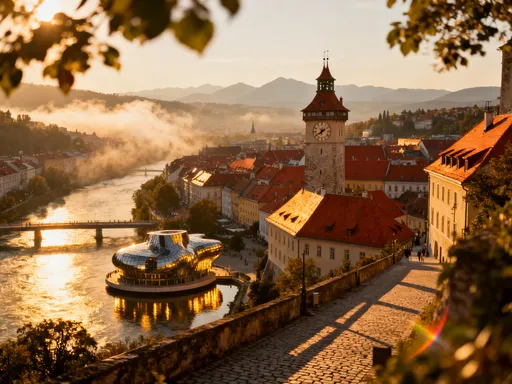
At the summit, the view is nothing short of transformative. On a clear morning, sunlight washes over the sea of terracotta rooftops, casting long shadows and highlighting the intricate geometry of the old town. The spire of the Cathedral of Graz rises prominently, while the modern curves of the Kunsthaus and Murinsel shimmer in the distance. The Mur River snakes through the scene like a silver ribbon, reflecting the sky and framing the city’s architectural dialogue between past and future. Visitors often pause at the viewing platforms near the Uhrturm, where benches invite quiet contemplation. The sound of the clock’s chime, carried on the breeze, adds a timeless rhythm to the experience. Whether arriving by foot or rail, the Schlossberg delivers not just a view, but a moment of connection with the soul of Graz.
Kunsthaus Graz: A Modern Vista with an Edge
If the Schlossberg represents Graz’s historical heart, the Kunsthaus Graz embodies its creative pulse. Opened in 2003, this striking building of blue acrylic panels and organic curves stands in bold contrast to the city’s traditional skyline. Designed by architects Peter Cook and Colin Fournier, the Kunsthaus—often nicknamed the “Friendly Alien”—is more than a museum; it is a landmark that redefines how art and architecture interact with public space. While entry is required to explore its galleries, the surrounding plaza and adjacent walkways offer freely accessible vantage points that are equally compelling for view-seekers.
The exterior of the Kunsthaus is designed to reflect and distort its surroundings, creating a dynamic visual experience that changes with the time of day and weather. From the eastern side, near the Mur River, the building appears to float above the water, its rippled surface mirroring the sky and treetops. The plaza in front, known as the Kunsthausplatz, provides an ideal spot to sit and absorb the scene. Here, visitors can watch as sunlight shifts across the façade, transforming it from translucent to luminous. In the evening, the building comes alive with programmable LED lighting, casting soft glows in shifting colors that turn the entire structure into a living canvas.
What makes this location particularly special for viewing is the dialogue it creates between old and new. Standing at the edge of the plaza, one can frame a perfect composition: the futuristic Kunsthaus in the foreground, the historic spires of the city center rising behind, and the Murinsel floating mid-river. Nearby cafés and benches allow for extended stays, making it easy to linger with a coffee or notebook. Families often gather here, children marveling at the building’s unusual shape, while photographers experiment with angles and reflections. The Kunsthaus proves that modern architecture, when thoughtfully integrated, can enhance rather than disrupt a city’s visual narrative—offering not just art inside, but beauty outside for all to enjoy.
Murinsel: Floating Perspectives on the River
Suspended in the middle of the Mur River, the Murinsel is one of Graz’s most inventive public spaces. Completed in 2003 as part of the city’s designation as a European Capital of Culture, this artificial island is a masterpiece of steel, glass, and imagination. Designed by New York artist Vito Acconci, it connects both banks of the river via two sweeping walkways, creating a seamless loop for pedestrians. But more than a bridge or a platform, the Murinsel functions as a floating stage for urban life—a place where people gather, rest, and, most importantly, see the city from a completely different perspective.
The island’s circular shape and transparent materials ensure 360-degree views, allowing visitors to turn slowly and take in the full panorama. From this mid-river vantage point, Graz appears both intimate and expansive. To the north, the historic center rises gently, its rooftops climbing toward the Schlossberg. To the south, the river stretches into the distance, flanked by parks and modern developments. The reflection of buildings in the water adds depth and symmetry, especially during calm mornings or twilight hours. Because the Murinsel sits at eye level with the riverbanks, it offers a more grounded experience than hilltop views—ideal for casual observation, conversation, or simply watching the world drift by.
Within the island, a central pavilion houses a café and event space, though the real attraction is the surrounding deck. Benches line the outer edge, inviting visitors to sit and absorb the flow of water and city life. In summer, the space buzzes with activity—musicians perform, couples share ice cream, and children run in circles, laughing. In winter, the atmosphere shifts to quiet contemplation, with frost on the railings and steam rising from the river. The Murinsel is not just a viewing platform; it is a living part of the city’s rhythm, proving that beauty can be functional, inclusive, and ever-changing.
Rooftop Cafés and Elevated Terraces
While natural and architectural landmarks provide the grand vistas, Graz’s elevated cafés and terraces offer a more personal way to enjoy the skyline. Scattered across the upper streets of the city center, these quiet retreats allow visitors to sip coffee, read a book, or share a conversation while gazing over rooftops and spires. Though specific venues may change over time, the experience remains consistent: a blend of comfort and elevation that transforms a simple break into a moment of urban appreciation.
One popular area for such spots is the network of side streets leading up from Hauptplatz, the main square. Here, small family-run cafés perch on gentle slopes, their outdoor seating arranged to maximize views. A café near the corner of Hofgasse and Schmiedgasse, for instance, offers a terrace that overlooks the tiled roofs of the old town, with the Schlossberg forming a green backdrop. In the early afternoon, sunlight filters through plane trees, dappling the tables and warming the stone walls. The menu often features Austrian classics—melange coffee, apple strudel, or herbal teas—served with a side of unhurried hospitality.
Further uphill, near the edge of the Stadtpark, a quiet bar on the upper streets provides a different kind of atmosphere. Open in the evenings, it draws a local crowd seeking golden hour light and a glass of regional wine. From its balcony, the city unfolds in layers—church towers, river bends, and distant hills merging into the horizon. The sound of distant church bells blends with soft music from the bar, creating a sensory experience that is both relaxing and inspiring. These elevated terraces remind us that great views don’t always require grand gestures; sometimes, they are best enjoyed slowly, with a warm drink in hand and no agenda at all.
Sunrise vs. Sunset: Timing Your View Chase
The magic of Graz’s views is deeply tied to timing. Like all cities, it wears different faces at different hours, and choosing when to explore can dramatically shape the experience. In central Europe, daylight patterns shift significantly between seasons, with long summer evenings and short winter days. Understanding these rhythms allows travelers to plan their viewing adventures for maximum impact—whether seeking solitude, clarity, or color.
Sunrise in Graz is a gift for the patient. Arriving at Schlossberg an hour before dawn means navigating quiet streets, often with only the sound of footsteps and distant birdsong. But the reward is profound. As the first light spills over the eastern hills, it bathes the city in a soft, golden hue, reducing shadows and enhancing detail. Photographers appreciate this time for its crisp air and even lighting, while meditative travelers find peace in the stillness. Morning fog sometimes lingers in the river valley, creating a dreamlike effect as buildings emerge gradually from the mist. Because most tourists begin their day later, sunrise offers a rare chance to have the viewpoints almost to oneself—a luxury in any destination.
Sunset, on the other hand, brings warmth and energy. As the sun dips behind the western hills, the sky ignites in shades of orange, pink, and purple, reflecting off glass façades and river surfaces. The city’s lights begin to flicker on—first the streetlamps, then the windows, and finally the illuminated landmarks like the Uhrturm and Kunsthaus. This transition from day to night is particularly striking from the Murinsel or a rooftop terrace, where the interplay of natural and artificial light creates a dynamic spectacle. While sunset draws more people, especially in summer, it also fosters a communal atmosphere—strangers smile, cameras click in unison, and the city feels alive with shared appreciation. Both times have merit; the choice depends on whether one seeks solitude or celebration.
Beyond the Postcard: Finding Quiet Corners with a View
While iconic spots like Schlossberg and Murinsel rightfully draw attention, some of the most memorable views in Graz are found off the beaten path. These are the quiet corners—small parks, residential side streets, and hidden benches—where the city reveals itself in unguarded moments. They require no tickets, no crowds, and no schedules, only a willingness to wander without a fixed destination.
One such place is a small green space along the southern edge of the Stadtpark, where a cluster of benches faces north toward the old town. From here, the view is partially framed by tree branches, creating a natural vignette that feels more intimate than panoramic. In autumn, falling leaves drift silently onto the path, and the air carries the scent of damp earth and woodsmoke. Another hidden gem lies along a residential lane in the Lend district, where a short staircase leads to a viewpoint overlooking the river and the Kunsthaus. It’s a favorite among locals, who stop here on their evening walks, pausing to breathe deeply and take in the quiet beauty.
These lesser-known spots remind us that travel is not only about seeing famous sights, but about cultivating presence. They invite slow exploration—turning down an alley because it slopes upward, lingering because sunlight hits a wall in an interesting way, or sitting simply because a bench offers a good view. In Graz, such moments are abundant, woven into the fabric of everyday life. They don’t always make it into guidebooks, but they often become the memories that last longest—the unplanned pause, the unexpected vista, the quiet awe of discovering a city not as a checklist, but as a living, breathing place.
The viewing experience in Graz is more than a collection of photo opportunities. It is a journey through layers of time, design, and nature—a chance to see a city from above and, in doing so, feel more connected to its rhythm and spirit. Whether from a historic hill, a modern marvel, or a quiet bench on a side street, each perspective adds depth to the traveler’s understanding. These moments of elevation offer not just visual pleasure, but emotional resonance—reminders that beauty is often found when we take the time to look up, slow down, and truly see. So pack light, walk slow, and let Graz reveal itself, one breathtaking view at a time.